Harmonics
Harmonics builds the surface displacement from a fundamental periodic wave plus integer-related overtones, similar to the harmonic series in sound. Interference between those partials yields richer lobes, beats, and organic-looking ridges than a single sine. It is a strong choice when you want complexity without the randomness of Noise or the hard steps of Glitch.
Preview
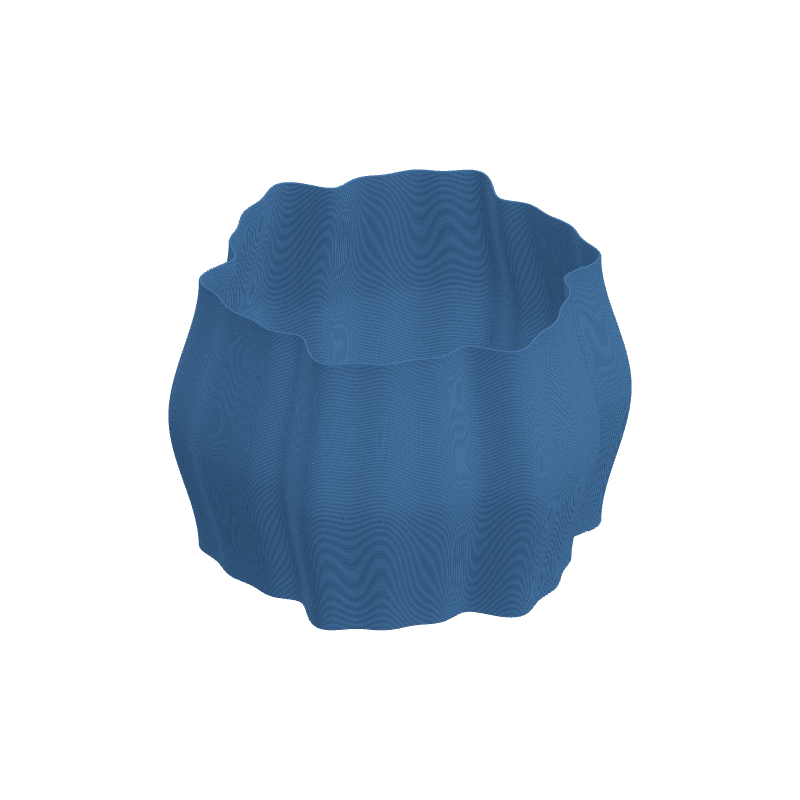
Effect Controls
Interactive preview is available in the interactive reader.
Parameters
Frequency- Fundamental angular frequency of the pattern (0.1–30). Sets the coarsest spacing of peaks around the layer; higher harmonics multiply this base.
Amplitude- Overall displacement strength in millimeters (0–10). Scales the summed harmonic waveform before it is applied to the mesh.
Stack Count- How many harmonic partials are mixed in (2–8). More stacks add finer ripples and moiré-like detail; two behaves like a simple wave pair.
Spread- Detune amount between partials (0–1). At zero, overtones stay in strict ratio; higher spread warps spacing so beats and asymmetry emerge.
Phase- Angular offset of the whole harmonic sum in radians (0–6.28). Rotates the composite pattern around the perimeter.
How It Works
The modulator evaluates several sinusoidal components whose frequencies are related to the base by small integer multiples, then adds them with weights derived from the stack count. Spread perturbs those ratios slightly so peaks and nulls drift around the form instead of repeating perfectly.
Because multiple components sum, you get constructive and destructive interference: some heights show tall ridges, others nearly cancel. Phase rotates the entire field so you can align features with seams or handles.