Envelope
The Envelope applies ADSR (attack, decay, sustain, release) shaping to radial displacement over the height of the part—borrowed from synthesizer envelopes. The surface moves in or out like a normal modulator, but the strength of that push follows a height curve: ramp up, optional dip to a sustain level, then fade out. Use it when you want a smooth bulge or pinch band that is strongest only in chosen vertical regions.
Preview
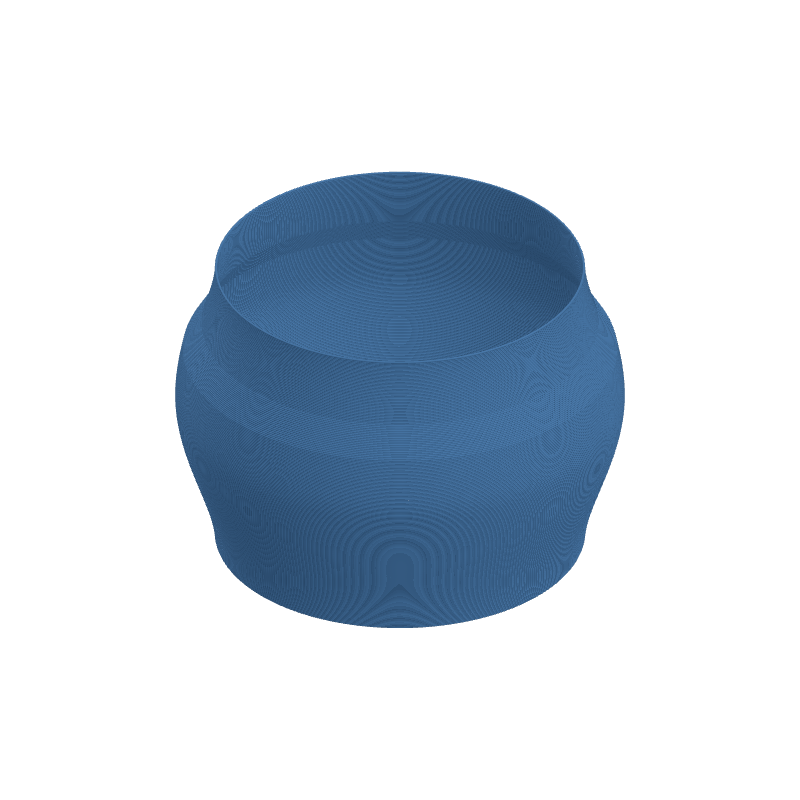
Effect Controls
Interactive preview is available in the interactive reader.
Parameters
Max Strength (mm)- Peak radial displacement when the envelope curve reaches 1 (0–10). The actual offset at each height is this value times the current ADSR level.
Attack- Fraction of total height used to rise from silence to the first peak (0–1). Larger attack softens the transition from the bottom of the print into full effect.
Decay- Portion of height after the peak over which the curve falls toward the sustain level (0–1). Controls how quickly intensity settles after the initial rise.
Sustain- Relative hold level during the middle of the shape (0–1). Higher sustain keeps the effect strong across the central band; lower sustain thins the middle.
Release- Final segment of height over which the envelope fades out toward the top (0–1). Longer release tapers ornamentation gently under the rim or cap.
How It Works
The modulator evaluates normalized height t from the base to the top of the print. In the attack segment, the envelope value rises from 0 to 1. Decay blends from that peak down toward sustain, which is held across the middle until release, where the value falls back to 0 at the top.
That envelope value multiplies Max Strength (via the same amplitude path as other effects) and the product is added as radial offset. So you get a single smooth “breathing” displacement profile in Z rather than a repeating ripple; other effects in the stack still combine with this offset in evaluation order.