Z-Ripple
Z-Ripple adds waves that primarily move the surface up and down along the build axis, so each layer undulates in height while traveling around the perimeter. The result reads as horizontal ridges, stacked bands, or shell-like ribs. It is the height-domain counterpart to XY-Ripple, which pushes the wall in and out radially.
Preview
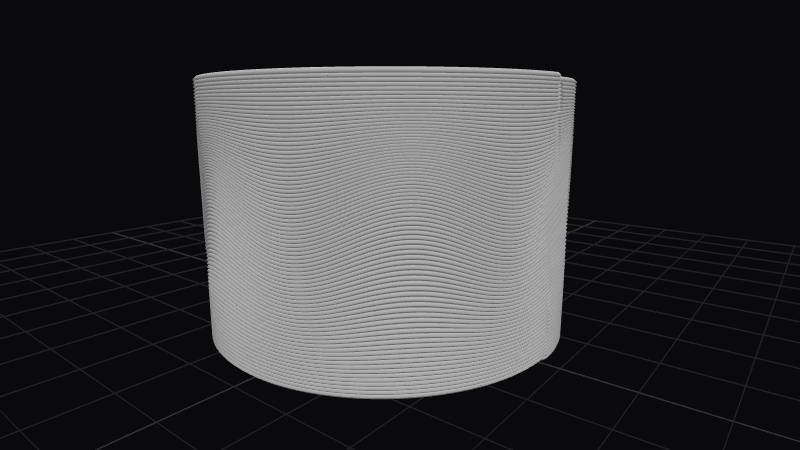
Effect Controls
Interactive preview is available in the interactive reader.
Parameters
Waves (N)- Count of wave peaks around the circumference (1–30). More waves pack tighter ribs; fewer create broad, slow undulations.
Height (mm)- Vertical excursion of each wave in millimeters (0–10). Sets how strongly the surface rises and falls in Z.
Bands (N)- Number of vertical bands or stacked sections the pattern is divided into (1–50). Use this to repeat the motif up the part without changing the angular wave count.
Spiral (°)- Progressive rotation of the wave phase as height increases (−1800–1800°). Positive values twist the pattern into a spiral; zero keeps waves aligned.
How It Works
A sinusoidal (or equivalent periodic) signal is evaluated as a function of angular position around the layer. Its value drives a displacement along the local vertical direction so the printed wall gains a corrugated profile in Z. The repeats parameter modulates how that pattern is sampled or phased along height, producing distinct horizontal bands.
Spiral offsets the phase linearly with height, shearing the ridges so they appear to wrap around the form—similar to twisting a stacked waveform.