Noise
The Noise effect adds pseudo-random displacement along the surface so prints read as organic, slightly imperfect, or naturally textured. It is useful for breaking up uniform geometry and hiding layer lines without a repeating pattern. Unlike ripples or harmonics, the variation is stochastic rather than strictly periodic.
Preview
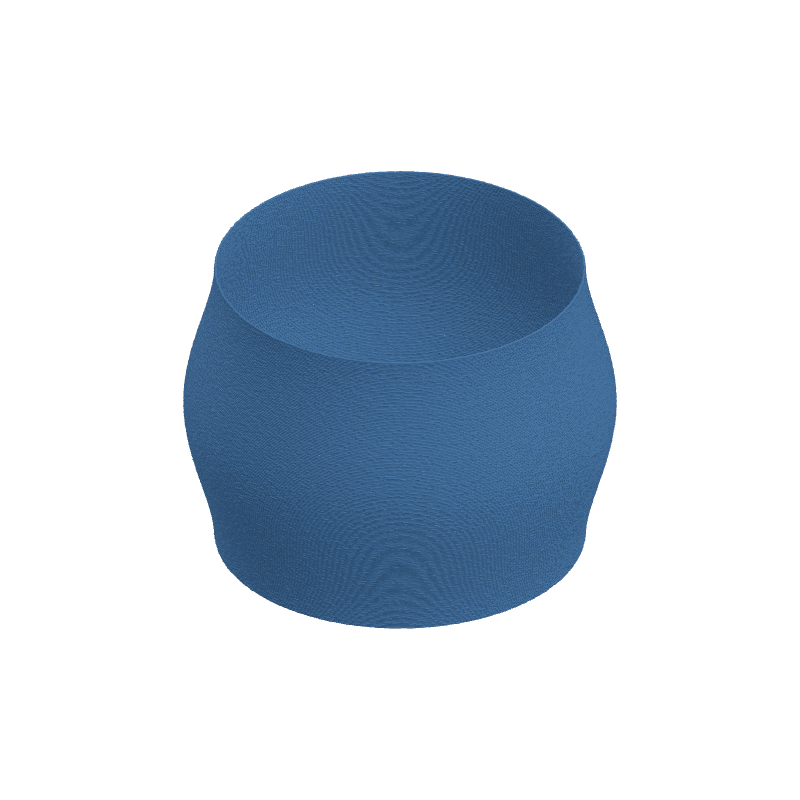
Effect Controls
Interactive preview is available in the interactive reader.
Parameters
Frequency- Spatial scale of the noise field (0.1–30). Higher values produce finer, more detailed bumps; lower values stretch variation over larger arcs of the perimeter.
Amplitude- Strength of the random displacement in millimeters (0–10). Larger values create rougher, more dramatic relief; small values add subtle grain.
How It Works
The modulator samples a smooth noise function (value noise with fractal-style layering in the engine) as a function of position around the layer and along height. That scalar is scaled by amplitude and applied as an outward or surface-normal displacement so each layer gets correlated but non-repeating variation.
Because the signal is continuous in angle and height, the result avoids hard steps while still feeling irregular. Other effects stacked after Noise will see the already-perturbed geometry.